Housing rights, housing wrongs

A recent case seen at our Croydon office highlights the urgent need for funding and reform
In late July, a woman with four children aged seven to fifteen came to South West London Law Centres’ Croydon office. The children had returned from their last day of school with their mother Ana* to find an eviction notice pinned to the front door of their temporary accommodation.
The notice told them that the locks had been changed, and that they had seven days to collect their belongings.
A lone parent who had fled domestic violence, Ana had requested a review of the property’s suitability for her family. It was located in a known crime hotspot in an area rife with antisocial behaviour.
Although Ana was offered alternative accommodation, she speaks limited English and wasn’t allocated an interpreter. This, along with a series of miscommunications – including Ana’s belief that the new accommodation wasn’t suitable for her additional mobility needs – meant that she rejected the offer.
Unbeknown to Ana, the consequence was to be her family’s eviction from their home.
“Although you can dispute an offer of accommodation, you only have 21 days after that to make a case that the accommodation is not suitable,” says SWLLC’s Campaigns, Policy and Community Manager, Rhiannon Hughes.
“As a result of this policy, the general advice is that families should accept an offer. Then, you can challenge the offer’s suitability, asking for a delay in being moved in until the review has been completed. But thanks to a communication breakdown, Ana wasn’t aware of any of this.”
Reaching out for help
Desperate for support, Ana presented herself and her children to her local council’s offices, looking for a place to spend the night.
Asked to leave at 5pm closing, she spent hours wandering the streets with her four children until, at 11pm, the family were placed in a hotel by Children’s Social Services. They were forced to share two mattresses between them in a damp, mouldy room.
It was the next morning, after a sleepless night, that Ana arrived at South West London Law Centres asking for help.
“Although we had no one to take Ana’s case on, this is the community’s Law Centre, and we won’t stand by while families are treated like this,” says Hughes.
“Due to sector-wide funding issues and the increasing challenges of maintaining experienced housing legal experts over the past decade, we currently have no housing solicitor or housing paralegal in our Croydon office, with work being carried out from our other offices.
“This is leaving a big skills gap within our team. Even so, we try to assist people in this type of urgent situation as best we can.”
HELP PEOPLE LIKE ANA BY SUPPORTING OUR WORK
SWLLC arranged an Economic Justice appointment for Ana and accessed an interpreter. Through conversations with the mother of four and an examination of her paperwork, it emerged that the family had been left homeless due to Ana’s rejection of accommodation.
“We thought through the possible legal challenges and understood that, as she was never offered an interpreter, the consequences of not accepting the offer weren’t explained or understood,” says Hughes. “With no court hearing, we believed the situation to be an illegal eviction.”
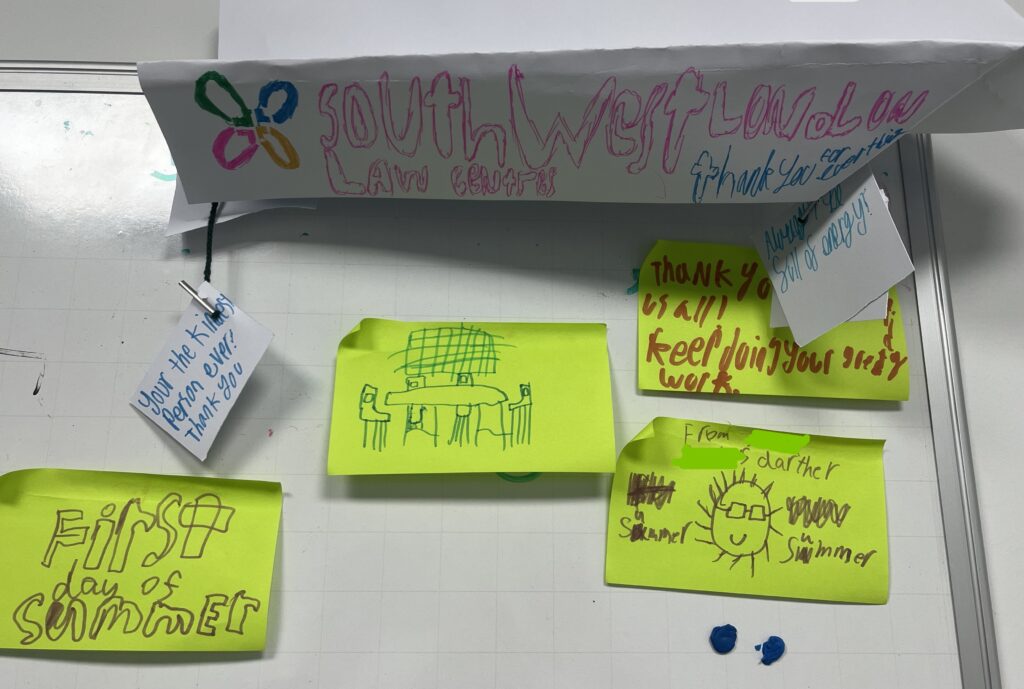
Some of the notes Ana’s daughter wrote while SWLLC staff dealt with her case
That night, after SWLLC had spent seven hours attempting to help the family to be rehoused, Ana was told to return to her emergency hotel accommodation. The following day, she returned to Croydon with her children, and the team resumed the fight for suitable accommodation.
“Essentially, the family was street homeless, yet no one was offering assistance,” Hughes says. “Two local councils had had contact with Ana and her family, but throughout our attempts to help them, we were passed from pillar to post.
“Neither council wanted to take full responsibility, despite there being four children involved.”
When three days had passed without a resolution, the Law Centre was concerned that the family would be left homeless over the weekend. They also had no access to their clothes or belongings, which were still locked in their former property.
Working with a solicitor based at another Law Centre, the team gained confirmation that the family could stay in their emergency hotel for the weekend. But after that, the family was left walking the streets, waiting for answers yet again.
“We were shocked that, despite so many agencies being involved, the family had no resolution to their horrific situation,” says Hughes.
Almost a week after being evicted, the council performed a U-turn, accepting that it had illegally evicted the family. The landlord was instructed to let them back into their home, where they could sleep on their own mattresses and change their clothes – necessities no child should ever be deprived of.
The need for long-term support
Although the family was illegally evicted, the council is now pushing for a legal eviction. This could mean Ana and her family could soon be in desperate need of additional support and access to legal justice.
Their story highlights the long-term effects of the changes to the Legal Aid scheme that happened in 2012, which are still being felt at Law Centres across the UK.
“SWLLC doesn’t have sufficient general funds to support our work, and the stagnation in Legal Aid funding has restricted our ability to attract and keep experienced housing lawyers or caseworkers,” says SWLLC CEO Patrick Marples.
“Over the last decade, our housing team has shrunk from 12 housing solicitors to two and half solicitors. The major focus of our work is now on emergency representation at court so people can stay in their homes. The recent Legal-Aid fee increases are welcome, but it will take time to rebuild our team – and help is needed now.”
SUPPORT OUR WORK BY DONATING, FUNDRAISING OR VOLUNTEERING
Ana is currently receiving support from a Law Centre solicitor, and SWLLC is keeping in contact with the family via our community outreach programmes. Her story is a shocking one – but it’s one we’re seeing more of, and that’s repeated every day across the UK.
People who desperately need access to justice are bring let down by a broken system that urgently requires more funding.
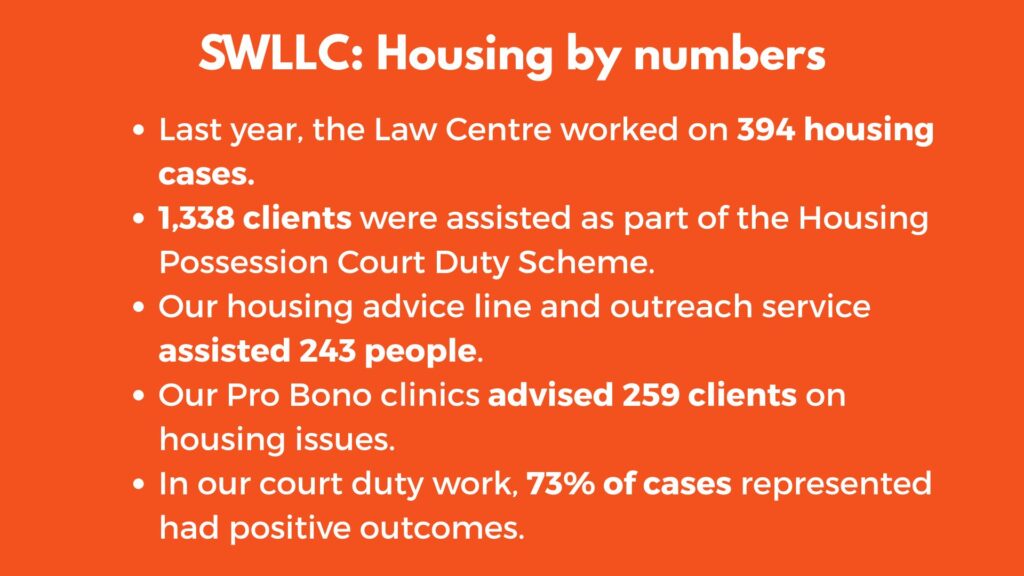
“We know we can have a meaningful impact when it comes to housing issues,” says Marples. “That might be through the people we represent via court duty, help offered during one-off Pro Bono advice sessions, or via our housing advice line. We also run community outreach programmes and campaign around the issue of temporary accommodation.
“But we also see day-to-day evidence that the housing situation is getting worse, not better. Where we’re unable to take on an urgent case, we try to refer and signpost. But that isn’t always possible, as Ana’s story shows.
“We’re seeing people’s lives being blighted, simply because there aren’t the resources there.”
If you’re in need of urgent housing help, you can access advice in our Housing Hub.
*Ana’s name has been changed to protect her identity